When I first got into forex trading as a beginner, I was completely overwhelmed. It was 2007, in my friend’s living room. I had no mentor, no strategy, and no clue how to trade forex. I was bouncing from YouTube videos to blog posts, trying to make sense of all the jargon. Currency pairs, candlesticks, leverage, it all felt like a foreign language. The strategies contradicted each other, the risks weren’t clearly explained, and no one talked about the emotional side of trading.
What I wish I had back then was a simple, honest guide to forex trading for beginners, something that covered the basics, warned me about common mistakes, and answered the real questions new traders ask when they’re just getting started.
If you’re starting your journey into forex trading, this guide is for you. It will save you time, money, and probably a few emotional meltdowns. I’ve put together honest answers to 53 real questions beginners like you are asking every day, things I had to learn the hard way.
No hype, no shortcuts, just what you need to survive your first few months, avoid costly mistakes, and actually start building confidence as a trader.
To make things even easier, I’ve organized these beginner questions into six clear categories. Whether you’re still figuring out how forex trading works, or you’re ready to open a demo account and start practicing, this guide will meet you right where you are.
Let me be real with you: forex trading is not a get-rich-quick scheme. But it is a skill you can master, and yes, you can make a living from it if you approach it like a real business.
What Forex Trading Really Involves
Forex trading, or foreign exchange trading, involves buying one currency while selling another, with the goal of profiting from changes in their exchange rates. It’s a global, decentralized market that runs 24 hours a day, five days a week, and it sounds exciting. But here’s the truth I wish someone told me upfront:
What I Wish Someone Told Me at the Start
What no one told me is that success in Forex is slow, steady, and often unglamorous:
- It’s not a quick win.
I used to think I’d double my account in a week. That mindset nearly wiped me out. Forex isn’t gambling, it’s a skill that takes time, patience, and emotional discipline. - You’re not just learning to trade, you’re learning to manage uncertainty.
Price movement, risk management, trading psychology, etc, they all matter. And they don’t click overnight. - You won’t master trading in 30 days.
You’ll lose trades, sometimes multiple in a row. It’s part of the process. What matters is how you respond, not how fast you succeed. - Success in trading is boring.
It’s not about chasing big wins. It’s about doing the same things well, over and over, reviewing your trades, following your system, and staying grounded.
If you’re just starting out, consider using a demo account. It lets you practice in a simulated environment with virtual funds, so you can test strategies and build confidence without risking real money. That’s how I began to rebuild my mindset, and eventually, my results.
If I could go back, I’d tell myself: be patient, use a demo account, and don’t try to “beat” the market. Just learn to understand it, and yourself.
The Tools I Still Use 10 Years Later
Don’t fall for the idea that you need 10 indicators or an expensive mentorship to start. These are the only tools I rely on:
- A reliable broker (with low spreads and solid withdrawal history)
- MetaTrader 4 or 5 (or TradingView for charting)
- Position size calculator (to avoid blowing your account)
- One working strategy, not ten untested ones
I’ve used the same basic setup for years. The power isn’t in the tools, it’s in how well you use them. That was how I was able to trade the Nonfarm Payrolls (NFP) profitably last week Friday, August 1, 2025. I built this tool myself to ease the intention between me and the market.
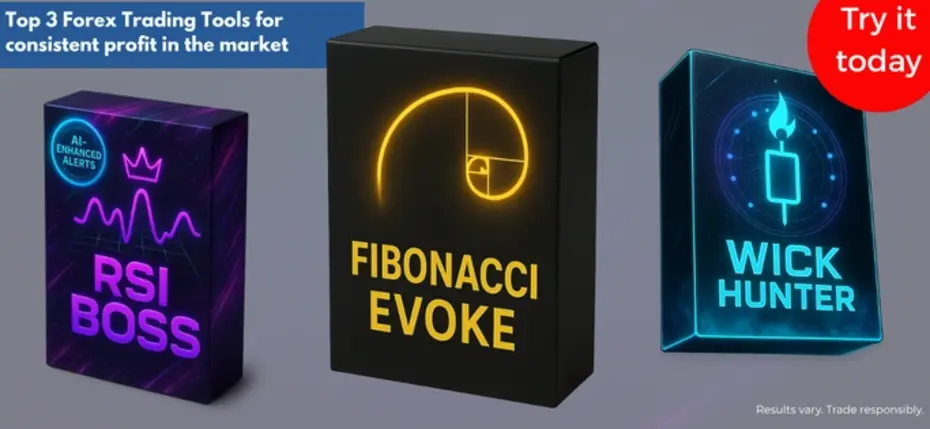
I’ve used the same basic setup for years. The power isn’t in the tools themselves, it’s in how well you use them. That’s how I was able to trade the Nonfarm Payrolls (NFP) profitably last week Friday, August 1, 2025. For anyone serious about Forex Trading for Beginners tools, this is the tool. I built these indicators to ease the tension between me and the market.
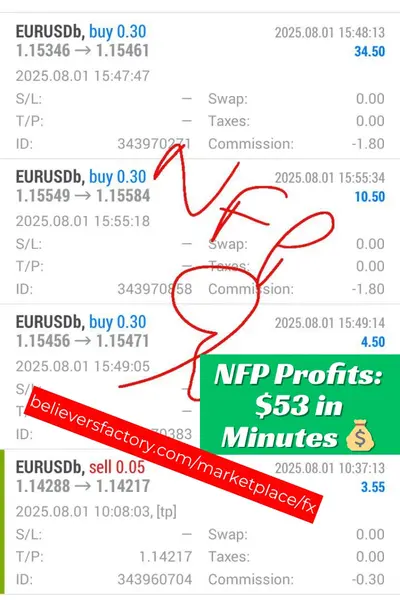
EUR/USD Nonfarm Payrolls (NFP) trade result showing a $53 USD profit on August 1, 2025, part of a real beginner-friendly Forex strategy
If you’re still using trading tools that only add more pressure, I highly recommend switching to these forex beginner-friendly MT4/MT5 indicators. They’re designed to simplify your experience and help you trade with more confidence.
Download the Fibonacci Levels Indicator for MT4/MT5, with Built-In Beginner-Friendly Entry Zones
Risks No One Talks About
Hidden Costs and Misunderstood Risks
No one talks about the real dangers, the subtle ones. Here’s what hurt me most:
- Swap fees: Overnight charges that drain small accounts
- Spread widening during news: You can get stopped out in seconds
Trading without sleep: Poor focus translate to poor decisions - Trading during low volume: Price moves erratically, and stops get hit
Understanding these risks is as important as understanding candlestick patterns.
My Own Wake-Up Call: USDZAR in 2018
Let me be real with you. I first heard about forex in 2007 through a friend, but everything felt overwhelming, so I gave up before placing a single trade. It wasn’t until 2018 that I came back, fully committed to learning it properly.
That same year, I saw headlines about South Africa entering a recession. Without fully understanding the mechanics, I jumped into a trade on USD/ZAR (US Dollar vs South African Rand). In just a few minutes, I was up $500; it felt like magic. I was so excited.
The next day, I went back into the same pair with the same confidence, but the trade went against me fast. I lost the $500 I made the day before and a large portion of my capital.
I now know this one thing. Market context matters, but so does timing, position sizing, and discipline. That emotional high from a lucky win can set you up for a painful crash if you’re not grounded in rules.
My Advice After Guiding Other Traders Through Their First Wins
What Most of Them Do Wrong at First
I’ve helped a few new traders through forums and personal chats. Most of them struggled with the same things I did:
- They chase strategy over discipline
- They trade too often and too big
- They don’t journal or review their losses
- They always wait until their take profit is reached even when the market condition has change
When I ask them why they entered a trade, most say, “It looked like a good setup.” That’s not a plan. it’s a gamble. A trading plan should have:
- Entry rule
- Confirmation rule
- Risk allocation
- Exit or invalidation plan
Now, let’s address the elephant in the room, the questions that mess with your confidence. At Believers Factory, we believe in forex, but only when it’s backed by confluence and patience. So before you make your next trade, go through these 53 real questions new traders ask, and avoid the mistakes that empty accounts.
Money, Funding & Capital Questions
1. Is $100 enough to start forex?
Technically, yes. Practically, it’s tough. With $100, you need micro lot sizing and tight risk control. You won’t flip it into $10K, but you can treat it as a practice account. Some brokers offer great micro lot conditions.
2. Can I trade forex with $5, $10 or $20?
You can open an account with some brokers, but spreads and commissions will crush your trades fast. Even with the best setup, tiny capital can’t absorb volatility.
3. Is $50 enough to start day trading?
Day trading with $50 is very limiting. You’ll have to risk less than $1 per trade. A better route might be funding challenges from a reliable prop firm.
4. Can I day trade with $100 or $500?
Yes, but you must trade small. A $100 account should never risk more than $1. With $500, you can do a bit more, 0.01 or 0.02 lot sizing max.
5. How much money do I need to begin forex trading?
$300 to $500 is a realistic minimum to practice properly with live trades. Want to skip small accounts? Try a prop firm evaluation instead.
6. What lot size is good for a $500 forex account?
0.01 lots. Possibly 0.02 for tight stops. If you’re risking more than 2% per trade, you’re doing it wrong.
7. How many lots can I trade with $10?
0.01 lots only. And even that is risky unless you trade major pairs during peak hours.
8. Why do you need $25k to day trade?
That rule applies to U.S. stock day trading. In forex, there’s no such rule, but capital still matters.
9. Can I trade with $1?
Yes, but it’s basically a demo with real emotion. It won’t teach you position sizing or execution under pressure.
10. What is the 50/50 trading strategy?
It’s not a formal rule, just slang for setups that offer a roughly 1:1 risk-reward ratio. Usually best avoided unless you’re scalping with high win-rate setups.
Psychology, Mindset & Learning Curve
11. Is forex trading good for beginners?
Yes, but only if you treat it as a serious skill. Most lose because they treat it like a side hustle or a get-rich-quick scheme.
12. Is forex trading gambling?
If you trade without rules or structure, yes. If you use logic, tools, and controlled risk, it becomes probability-based decision making.
13. Can a normal person do forex trading?
Yes. I did. Most traders are self-taught. If you can follow simple rules and stick to structure, you can trade.
14. Can I teach myself forex trading?
Yes, and many successful traders did. But don’t rely only on free content. Pair your learning with tools like Fibonacci Evoke that show structure live on the chart. And it’s easy for beginners avoid losses.
15. Is forex hard for beginners?
It can be. The hardest part isn’t the chart; it’s your emotions, discipline, and sticking to one system long enough to see it work.
16. Is it too late to learn forex?
Not at all. If you can manage risk, follow a plan, and ignore hype, you’re probably starting at the right time.
17. How quickly can I learn forex?
Basics? A few weeks. Trading profitably under pressure? Give it 6 to 12 months.
18. Can I learn forex by myself?
Yes. But feedback speeds things up. Journal your trades. Watch structure. And use tools like Fibonacci Evoke to track the 50% level smart traders watch.
19. Why do 80 – 90% of traders fail?
They overleverage, skip journaling, and jump strategies too often. Most don’t stick to any real structure.
Trading Psychology Tips
My 5 Mindset Rules for Survival
Here’s what saved me when I was ready to quit:
- Never take revenge trade. I’ve never seen someone come back from a loss with an emotional trade and win long term.
- Always use a stop-loss. Hope is not a strategy.
- Don’t check your P/L while in a trade. It feeds anxiety and leads to premature exits.
- Accept losing streaks. They are part of every profitable trader’s life.
- Respect your edge. One setup done well beats five random trades.
The market doesn’t owe you a win because you showed up – Warren Buffett
Strategy, Rules & Smart Execution
21. What is the 1% rule in forex?
Never risk more than 1% of your total capital per trade. This keeps your account alive during losing streaks.
22. What is the 5-3-1 rule in forex?
- Trade 5 pairs
- Use 3 strategies
- Focus on 1 time of day
It’s a simplification model to reduce overwhelm.
23. What is the 90% rule in trading?
Often quoted as: 90% of traders lose 90% of their capital in 90 days. Take it as a warning to respect the process.
24. What is the 3-5-7 rule in trading?
A discipline model: Give yourself 3 minutes to analyze, 5 minutes to decide, and 7 minutes to enter. It’s more for mental control.
25. What is the 84% rule in trading?
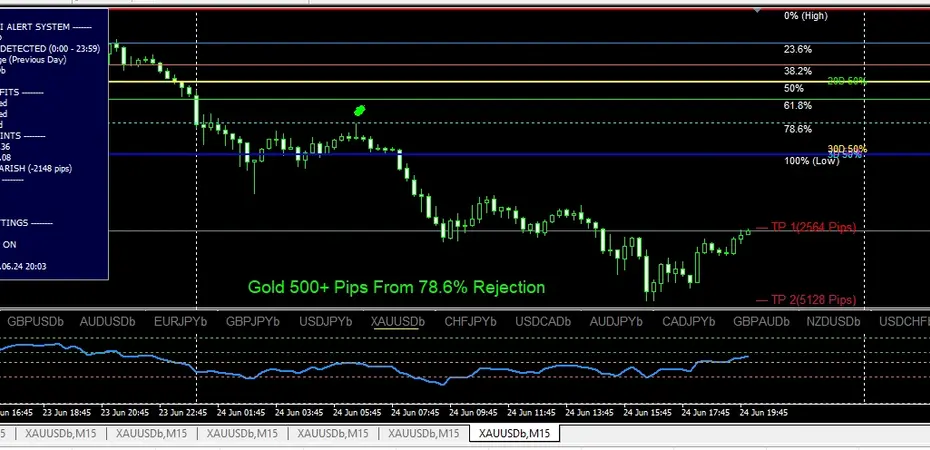
It refers to statistical probabilities in retracements. For example, 84% of the time, price reacts to fib zones during normal volatility. Fibonacci Evoke is built around these probabilities.
26. What is the 70/30 trading strategy?
It’s a risk-adjusted approach: only take trades that give you a 70% edge, or set your reward-to-risk ratio to 70:30.
27. What is the No. 1 rule of trading?
Protect your capital. No edge matters if you’re bleeding from oversized losses.
28. What is the 12345 in trading?
Refers to wave structures (like Elliott Wave), but for beginners, it’s best not to overcomplicate. Focus on swing highs/lows and fib zones.
30. What is the 130/30 strategy?
More common in hedge funds, long 130% of capital and short 30% to create a net exposure of 100%. Irrelevant for most retail forex traders.
31. What is the most powerful Fibonacci retracement level?
The 50% level is psychologically and structurally powerful. Institutions often trade it. Fibonacci Evoke tracks this in real time.
Tools, Indicators & Learning Resources
32. What indicator do professional traders use?
Structure. Volume. Fib tools. Price action. Many use custom tools like Fibonacci Evoke to visualize historical fib zones without redrawing manually.
Download the Fibonacci Levels Indicator with Built-In Entry Zones
33. Which indicator has the highest accuracy?
No indicator is 100% accurate. But fib levels (especially multi-day 50% zones) have shown strong reliability during overlapping sessions.
34. Why don’t professional traders use indicators?
They rely more on structure, price behavior, and volume than colorful indicators. If they use tools, they’re purpose-built, like Fib-based alerts or order flow.
35. Do professional traders use MACD?
Some do, usually for confirmation. But most pros rely more on price and structure.
36. How to use Fibonacci perfectly?
Use it only when there’s a clear swing high and low. Let price pull back into a key level, then look for a reaction. Tools like Fibonacci Evoke automate this process.
37. How to reverse Fibonacci?
Start from the low to the high if you’re measuring a bullish move; from high to low for a bearish one.
38. How to reset Fibonacci retracement?
Delete it and redraw on a new swing. Or let Fibonacci Evoke auto-detect for you.
How to Stay in the Game Long Term
The 3-Step Learning Cycle I Repeat Monthly
After years of blowing accounts, I built a rhythm that keeps me focused and profitable:
- Plan weekly: Set levels, expected zones, and news to watch
- Trade mid-week only: I avoid Mondays and Fridays unless I see a clean setup
- Review every weekend: I journal setups and tweak based on my results
That cycle is how I avoid burnout, control overtrading, and stay mentally clear.
Also, don’t trade alone. Join a small community or follow a mentor who shows their trades and their thinking.
Platforms, Countries, and Getting Started
39. How to start forex as a beginner?
- Open a demo account with a trusted broker
- Learn basic charting and price structure
- Study 1–2 simple strategies and practice consistently
- Focus on risk management first, profits second
40. Which trading is best for beginners?
Forex is great due to accessibility and leverage, but crypto and stocks are also valid. Forex offers structured sessions and lower starting capital.
41. What trading is most profitable?
Scalping can be fast, but risky. Swing trading with confluence (like fib levels, support/resistance, and trend) gives the best risk-reward over time. Fibonacci Evoke helps you spot these setups easily.
42. What is the safest trading?
Trading structured zones like 50% and 78.6% retracements during high-liquidity hours is one of the safest ways. Avoid revenge trading or overtrading. Patience is safer than speed.
43. What are the best European countries for traders?
Germany, the Netherlands, and the UK have good infrastructure, access to brokers, and favorable regulation. If you’re in Europe, check your country’s leverage laws.
44. Which European country is best to start a business?
For trading and fintech, Estonia and Cyprus are common because of tax and regulation benefits. Always seek professional legal advice if you’re setting up a business.
45. What does the EU trade the most?
Mainly machinery, cars, chemicals, and food products, not directly related to forex unless you’re trading news tied to the euro.
46. What attracted European traders?
Low barrier to entry, flexible markets, and tech. Also, major pairs like EUR/USD are among the most liquid in the world.
💼 Profitability & Career Questions
47. Can trading make you a millionaire?
Yes, but it takes time, consistency, and scale. Most who succeed treat it as a profession, not a quick win. Prop firm capital can help accelerate that growth. Explore prop firms here.
48. Can I get rich off forex?
Not overnight. But over 3 to 5 years of consistent trading and compounding gains, yes, if you follow rules and scale slowly.
49. Can you make a living from forex?
Yes, especially with funded accounts and smart withdrawals. Even $100/day is life-changing in many parts of the world.
50. Is day trading illegal?
Not at all. But follow your country’s tax rules. If you’re earning consistent income, register it legally.
51. Is day trading a real job?
Yes, but only if you treat it like one. If you only dabble or skip journaling and analysis, it remains a hobby.
52. Does trading get boring?
Once you master the system, yes. But boring is profitable. The fewer surprises, the more consistent your results.
53. How long does it take to learn forex?
Expect 6 to 12 months to become competent. Faster if you learn daily and use structured tools like Fibonacci Evoke.
Final Thoughts
You don’t need to master everything today. But if you’ve made it to the bottom of this list, you’re already ahead of most new traders.
Forex trading can feel overwhelming at first, especially with all the noise, flashy strategies, and complicated tools that promise instant results. But the truth is, it’s not a quick win. It takes time, patience, and a solid trading mindset.
Throughout this guide, I’ve answered 53 real questions that beginner traders ask because I’ve lived through them, the confusion, the emotional ups and downs, and the temptation to chase shortcuts. I know what it’s like to lose money early and wonder if you’re cut out for this.
The secret? Focus on the basics of how forex works, avoid the common mistakes new traders make, and take risk management seriously. Most importantly, invest in your trading psychology, that’s what will keep you grounded when the market doesn’t go your way.
If you’re just starting out, I recommend you start with a demo account. It’s the safest way to learn, test strategies, and build real skills without risking your capital.
Remember: success is consistency. Ask smarter questions. Stick with tools that reduce overwhelm and help you trade with confidence. And when you’re ready to trade with more clarity, check out the custom indicator I use every day, built by a trader, for traders.
Download the Fibonacci Levels Indicator for MT4/MT5, with Built-In Beginner-Friendly Entry Zones
If you’re struggling to recognize price structure or know where to enter 👉 Learn how Fibonacci Evoke helps new forex traders identify structure and make smarter entry decisions and test it out on a demo account first.
Want to trade live? Start with a reliable forex broker or try a prop firm funding challenge to access more trading capital.
Disclaimer
What I’ve shared in this post comes from my personal trading journey, guided by experience, learning, and faith. It’s meant to encourage and educate, not to guarantee results or offer financial advice. Forex trading carries risk, and it’s wise to seek God’s guidance, do your own research, and speak with a licensed financial advisor before making any trading decisions.



jwkopulstlnlswyxeqjoufqsookipn
You can certainly see your expertise in the work you write. The world hopes for more passionate writers like you who are not afraid to say how they believe. Always go after your heart.
My brother suggested I might like this website. He was entirely right. This post actually made my day. You cann’t imagine simply how much time I had spent for this information! Thanks!
wow your article is simply a masterpiece, i like that, keep it up and will be checking for new update. do you post often? you can check the biggest webdesign freelancer in platform in germany called https://webdesignfreelancerfrankfurt.de/ Thank you for your wonderful post
as a professional seo expert in hamburg, i can tell your article is professionally written, i enjoy reading it, keep up the good work, do you post more often ? i am now a follower, you can take a look at my site as the best seo expert in hamburg https://seoexpertehamburg.de/ Thank you