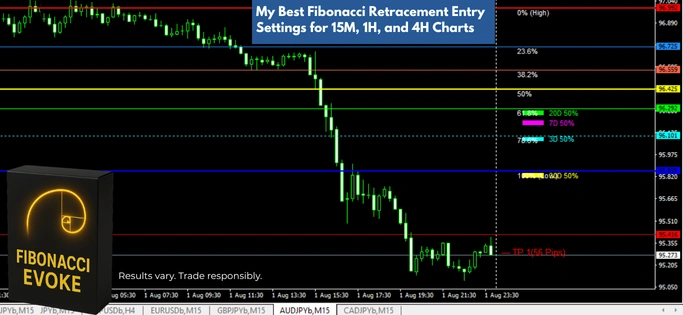
Ask ten traders what their Fibonacci retracement entry settings are, and you’ll get ten different answers.
Some stick to 38.2% and 61.8%. Others swear by 50%. And a few throw in everything from 23.6% to 261.8% like confetti. But if you’re not tailoring your fib settings to your timeframe, you’re flying blind.
Fibonacci retracement levels are those horizontal lines you see on your chart that show where price might pull back or change direction. They often act like support or resistance as soon as you place the tool on your chart.
That’s where Fibonacci Evoke comes in, it fixes this blind spot by adapting your levels to the structure of your chart, not just textbook numbers.
Whether you’re scalping the 15-minute chart or trading swings on the 4H, Fib Evoke adjusts your fib settings to match your market structure, not some textbook rule.
Traders often ask: What’s the golden rule of Fibonacci retracement? Simple, trade from structure, not noise. That starts with the right settings.
So, in the simplest way possible, we’ll go over the Fibonacci retracement settings that match your trading style, especially with the help of Fibonacci Evoke, the new tool on the block.
Why Fibonacci Retracement Entry Settings Matter More Than You Think
Using the wrong fib levels for your chart is like showing up to a Formula 1 race with bicycle tires. Your setup might look fine, but it won’t hold when the market moves. You will see different levels from the rest of the world.
Here’s the simple truth. Different timeframes call for different fib depths and extensions.
- On lower timeframes (like 15M), price reacts faster and tightly. Levels like 23.6% or 38.2% matter more.
- On swing timeframes (1H or 4H), deeper pullbacks to 50%, 61.8%, or even 78.6% often define the real reversal zones.
AUDJPY H4 chart showing a 196-pip move after rejecting the 78.6% Fibonacci retracement level from Fibonacci Evoke’s Weekly Range Mode.
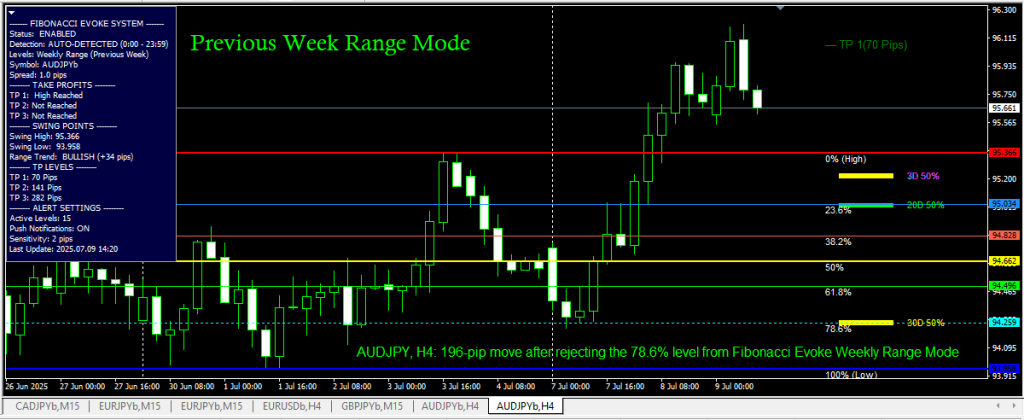
That’s why Fibonacci Evoke lets you customize everything, including which levels to plot, their color, width, and whether to show them at all.
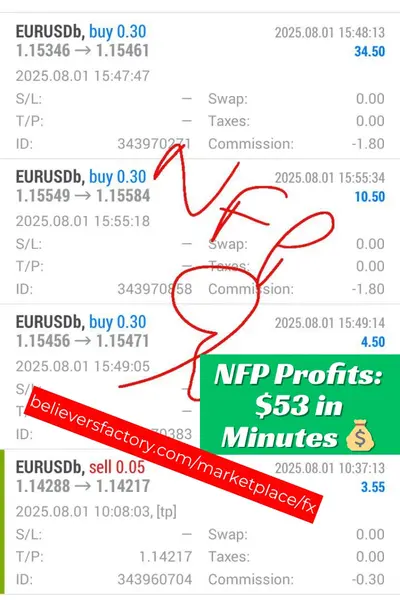
Exactly what I did, when I traded NFP yesterday (August 1, 2025) using these same settings, I caught 3 clean scalps on EURUSD, all off the Fibonacci reaction zones I personally configured inside the tool. And help from RSI Boss and Wick Hunter indicator for clear entries.
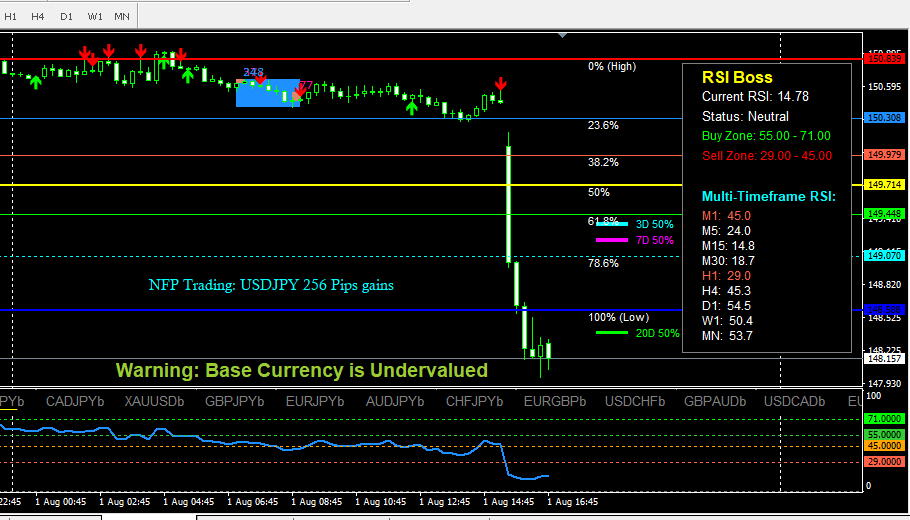
💰USDJPY M15 chart showing a 256-pip NFP drop on August 1, 2025. Entries marked with Wick Hunter, zones from Fibonacci Evoke, RSI sentiment at extreme.
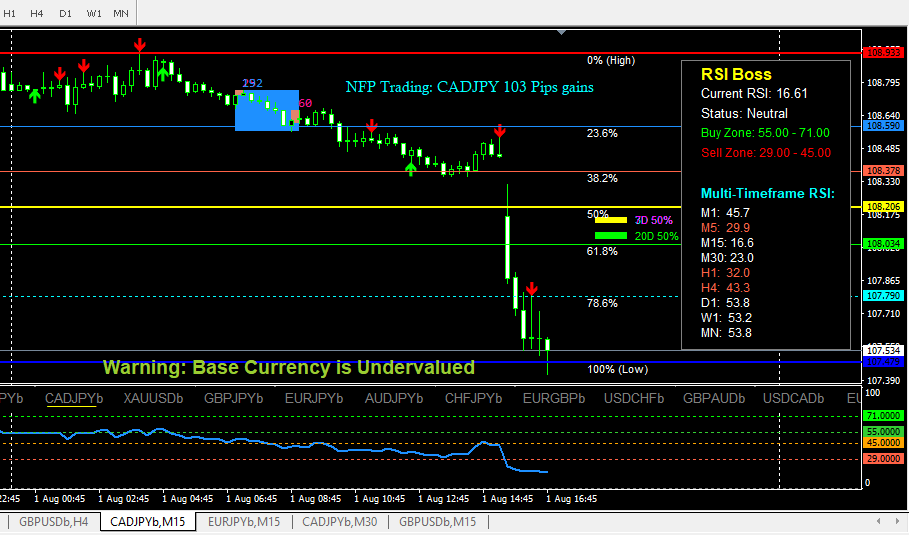
CADJPY chart on NFP day (August 1, 2025) with 103-pip gain. Trade confirmation came from Fibonacci Evoke zone reversal and RSI Boss oversold signal.
GBPJPY M15 chart showing a 197-pip NFP move captured using Fibonacci Evoke levels, RSI Boss dashboard, and Wick Hunter wick rejection signals. Trade entries and price zones marked clearly.👇
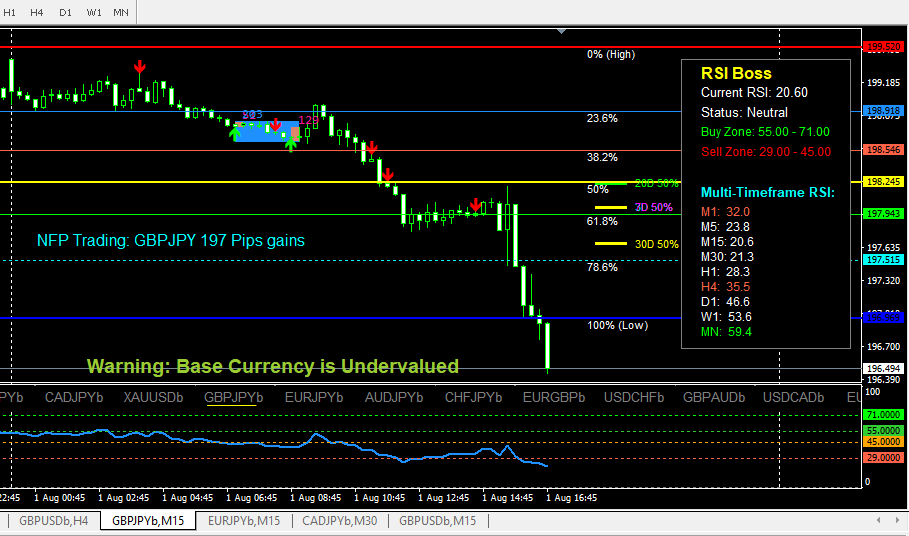
By setting up your Fibonacci retracement tool correctly, especially using the 23.6%, 38.2%, 50%, 61.8%, and 78.6% levels, you give more weight to your support and resistance zones. This often leads to clearer trade entries and more profitable results, just like the charts above.
Before you learn about the custom settings, make sure you understand how Fibonacci Evoke plots its swing levels and profit zones. Read the full breakdown here
Intraday Range Mode Settings: Asian, London / New York overlap, etc.
Fibonacci Evoke Intraday Range Mode input settings panel showing configurable Fibonacci retracement entry settings level for real-time intraday trading.
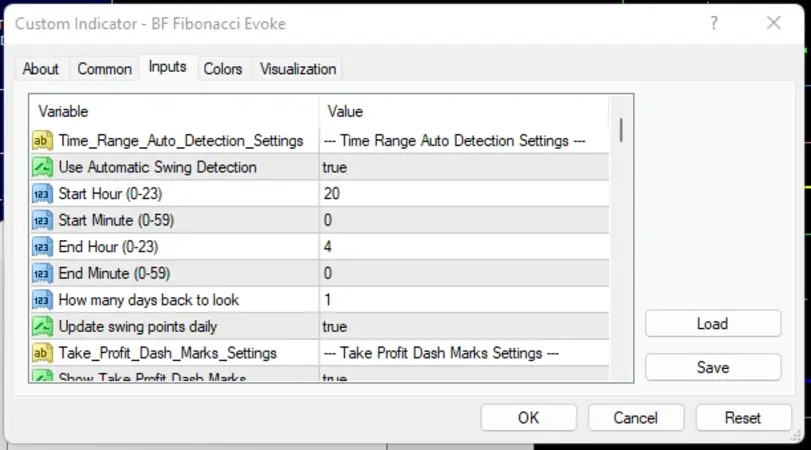
Previous Day Range Mode Settings
Fibonacci Evoke Previous Day Range Mode input settings panel for customizing retracement levels based on the prior day’s price range.
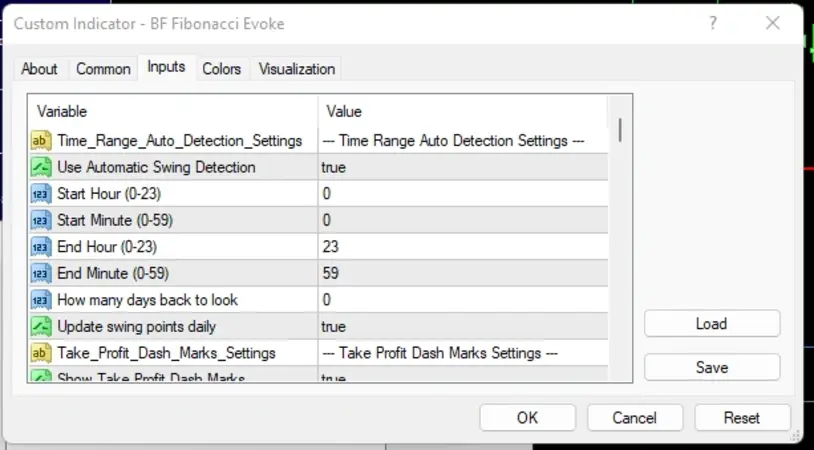
Weekly Range Mode Settings
Fibonacci Evoke Weekly Range Mode input settings panel showing custom retracement configuration for higher timeframes.
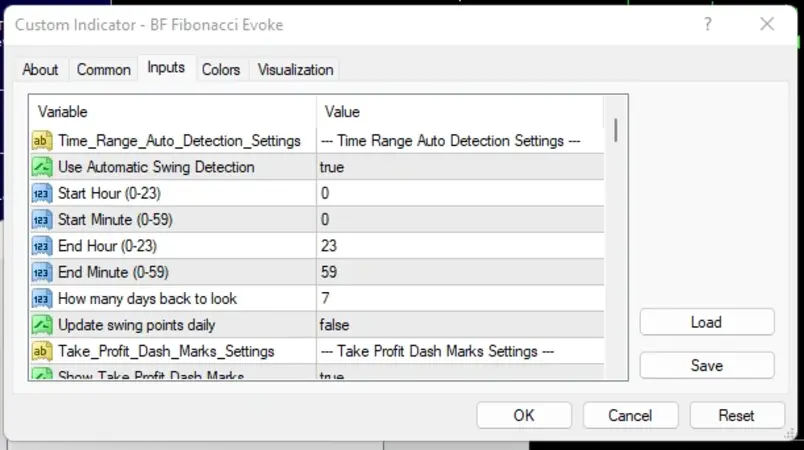
How I Use Fibonacci Retracement for Entry?
Fibonacci retracement is used for entry by identifying pullback levels where price is likely to resume its original trend. Traders often look for reactions around the 38.2%, 50%, or 61.8% levels, especially when these align with structure or session highs/lows.
I’ve personally found that using the 78.6% level during the London session gives me the best entry on EURJPY and GBPUSD, especially after price sweeps liquidity. With Fibonacci Evoke, I now customize levels by session range, not one-size-fits-all templates. This precision matters, especially when switching between 15M and 4H charts.
My Recommended Settings by Timeframe
Based on my personal experience and over 100+ live trades using Fib Fib Evoke, here’s what I recommend:
1. 15-Minute Chart (Scalping)
Use These Levels:
- 23.6% (momentum)
- 38.2% (quick pullback)
- 50% (most reactive midpoint)
- 127.2% (extension TP)
Scalping needs speed. These levels help you catch shallow pullbacks without missing the move.
2. 1-Hour Chart (Intra-Day Swings)
Use These Levels:
- 38.2%, 50%, 61.8% (classic structure)
- 78.6% (late entry, high-risk/reward)
- 161.8% (extension TP)
The 1H gives you enough range to wait for cleaner fib-based setups and plan Takeprofit (TP) with accuracy.
3. 4-Hour Chart (Swing & Position Trading)
Use These Levels:
- 50%, 61.8%, 78.6% (core retracements)
- 127.2%, 161.8%, 261.8% (targets)
- Optionally: 423.6% for breakout trades
Did you know that higher timeframes absorb noise? These deeper levels give you structure, while the extensions show where big players aim.
Why Fibonacci Evoke Makes Retracement Easier
Most tools force you to manually adjust fib settings per chart.
Fibonacci Evoke solves this by letting you:
- Choose which retracement and extension levels to display
- Adjust colors, widths, and style per level
- Switch between daily and weekly fibs for multi-timeframe clarity
- Plot fibs based on session time (like London to New York overlap)
- Use TP1 to TP3 levels calculated off the swing range, no math needed
I used to run the same Fibonacci levels across all timeframes, M15, 4H, even Daily. Big mistake. With Fibonacci Evoke, I finally see what each chart really needs. Now, my Fibonacci retracement entry settings are top-notch.
Different timeframes need different Fibonacci setups. If you’re using the same one on M15 and 4H, you’re losing precision. Fibonacci Evoke solves that in one click.
Comparing Intraday vs Previous Day vs Weekly Fibonacci Entry Precision
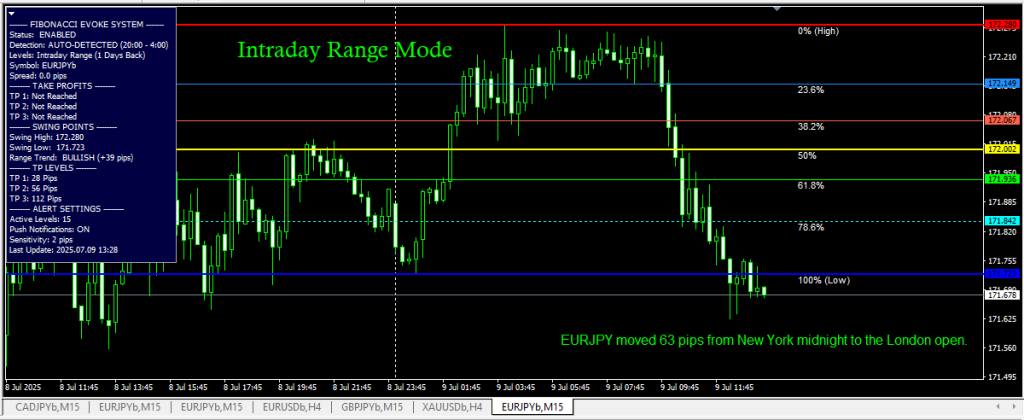
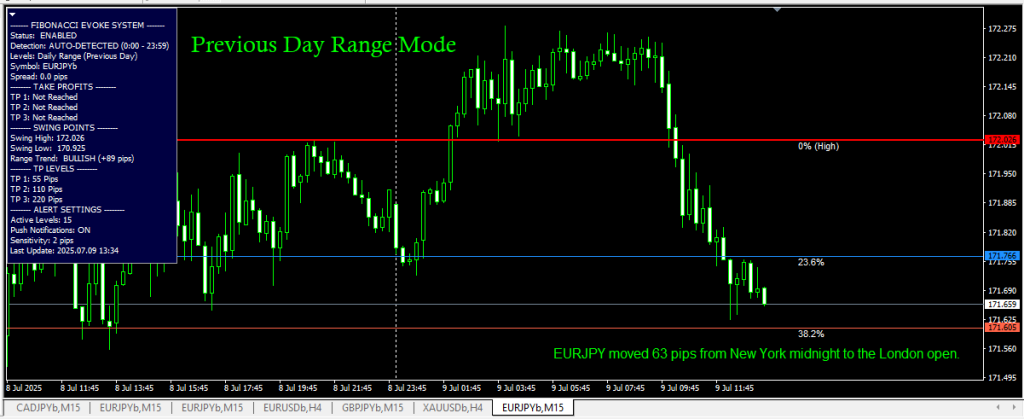
Not all Fibonacci retracements are created equal, especially when timeframes shift. Let me walk you through a real 63-pip move on EURJPY during the New York midnight to London open today, 9th July. We’ll see how the same price action behaves under three different Fibonacci Evoke range modes: Intraday, Previous Day, and Weekly. The goal is to show you how choosing the right mode sharpens your entry and filters out noise that doesn’t matter to your setup.
EURJPY 63-pip move from New York midnight to London open, showing ideal Fibonacci retracement settings and best entry on the 15M chart using Fibonacci Evoke’s Intraday Range Mode.
EURJPY 63-pip move from New York midnight to London open, showing ideal Fibonacci retracement settings and best entry on the 15M chart using Fibonacci Evoke’s Previous Range Mode.
EURJPY 63-pip move from New York midnight to London open, showing ideal Fibonacci retracement settings and best entry on the 15M chart using Fibonacci Evoke’s Weekly Range Mode.
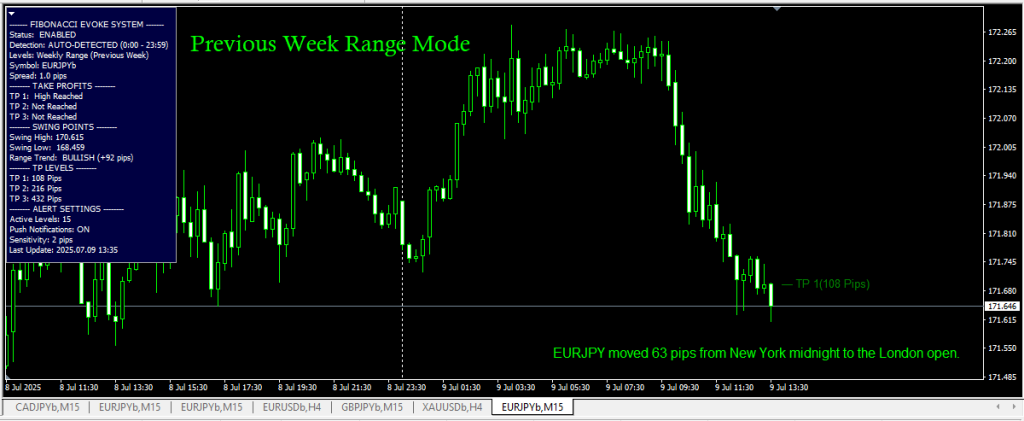
As you’ve just seen, each Fibonacci Evoke range mode interprets the same move differently, and that matters. From the charts, it’s clear that Intraday Mode delivered the most precise entry (short-term scalping), perfectly syncing with the 63-pip EURJPY move on the 15M chart. Previous Day Mode also offered a clean retracement structure, confirming key reaction zones from the prior session.
But with Weekly Mode, no meaningful Fibonacci levels aligned with the move at all. That’s because the Weekly range is simply too broad to deliver precise entries on a lower timeframe like 15M sometimes (that’s I suggest using it on H4).
This goes to show that your retracement settings must match the timeframe you trade, or you’ll miss the move entirely, along with the best entry. No waiting for a break of structure (BOS), no chasing change of character (CHOCH), and no need to draw trendlines. You just trade what’s in front of you.
That’s exactly what Fibonacci Evoke solves, it keeps your entries time-aligned, not just price-aligned.
👉 Click here to get Fibonacci Evoke, and trade with precision that fits your chart.
What is the Retracement Entry Strategy?
A retracement entry strategy is waiting for price to pull back to a key Fibonacci level (support or resistance) before entering in the direction of the main trend. This avoids chasing breakouts and allows better risk-reward setups.
My go-to retracement entry strategy involves anchoring fibs to the Asian session range, then watching for price to revisit levels like 61.8% or 78.6% during the London or New York open. I avoid placing entries during the overnight chop. With Fibonacci Evoke, I automate this process, each timeframe adjusts based on its most recent, relevant swing.
Why is 61.8 a Golden Ratio?
The 61.8% level is called the golden ratio because it’s derived from the Fibonacci sequence and appears naturally in nature, geometry, and financial markets. It reflects a powerful balance point where trends often react.
In trading, 61.8% is not magic, but it’s statistically significant. Markets often retrace to this point before continuing in the original direction. But it’s not universal. On faster charts like 15M, I’ve seen more reliable reactions at 38.2% or 78.6% depending on session volatility. That’s where Fibonacci Evoke’s time-based mode shines, it adjusts for what matters on that chart and timeframe.
How Range Settings Help You Fine-Tune Your Timeframe Strategy
One of the most underrated features in Fibonacci Evoke is the ability to control the swing range it uses to plot fib levels.
This is what I mean
1. On 15-Minute Charts
Use the “Session” range mode setting to focus only on the high and low during key periods, like the London to New York overlap (2 PM – 5 PM WAT). This keeps fib levels tight and reactive for scalping.
I personally like to use the Asian high and low to catch the moves of the New York midnight to the London session.
This alone helps me avoid plotting Fibonacci levels based on overnight noise that has nothing to do with the real move forming.
2. On 1-Hour Charts
Use the “Previous Day” range mode. It gives you the full range of yesterday’s trading activity and adapts fib zones accordingly. Ideal for catching intraday continuation or reversal setups.
3. On 4-Hour Charts
Switch to “Weekly” range mode. This lets Fibonacci Evoke calculate the swing based on the entire previous week, giving you deeper structure and better insight into where larger players are watching.
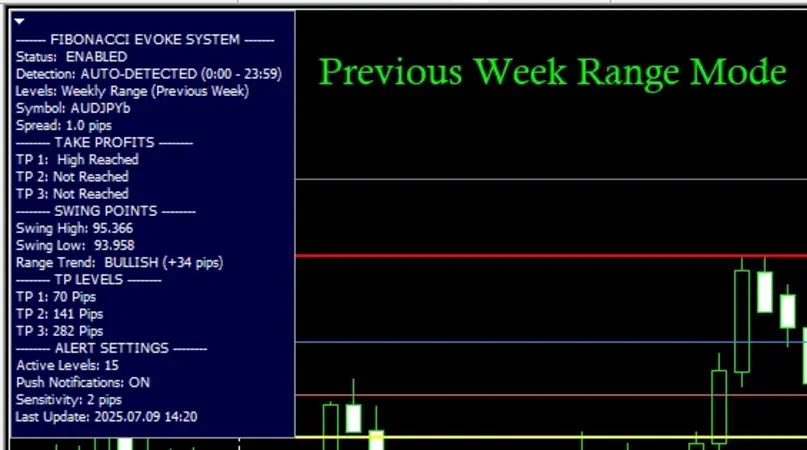
I used to manually calculate these ranges with a calendar and candle scanner. Now Fibonacci Evoke does it in seconds, and my fibs are finally aligned with the timeframe I’m actually trading.
Knowing where to place your Fibonacci retracement depends on how you define your swing. That’s where Fibonacci Evoke’s range modes help, from intraday to weekly.
Frequently Asked Questions About Fibonacci Retracement Settings
What are the best settings for Fibonacci retracement?
The best settings depend on your trading timeframe. For scalping (15M), use 23.6%, 38.2%, and 50%. For 1H to 4H charts, 50%, 61.8%, and 78.6% are more reliable. Fibonacci Evoke lets you choose the exact levels that match your style.
Which timeframe is best for Fibonacci retracement?
There’s no single best timeframe, it depends on your strategy. Scalpers use 5M to 15M; swing traders prefer 1H to 4H. Fibonacci Evoke adapts to all of them by letting you switch range modes and levels easily.
What is the golden zone of Fibonacci retracement?
The golden zone usually refers to the range between 61.8% and 78.6%. These are powerful reversal areas, especially on higher timeframes. Evoke marks them clearly and alerts you when price enters that zone.
What are the best Fibonacci levels to take profit?
Common profit targets are at the 127.2%, 161.8%, and 261.8% extension levels. Fibonacci Evoke plots TP1, TP2, and TP3 based on your selected swing, no calculator needed.
What is the most powerful Fibonacci retracement level?
While 61.8% is often called the “golden ratio,” many traders consider 78.6% to be the most powerful reversal level, especially when confirmed by price action. Fibonacci Evoke includes both.
How to draw Fibonacci retracement correctly?
Start from the swing high to low (for downtrends) or low to high (for uptrends). Make sure the move is recent and clean. Fibonacci Evoke does this automatically, using session, daily, or weekly swing logic.
Final Thoughts
Fibonacci retracement entry settings aren’t something smart traders leave to chance anymore. Nowadays, smart traders don’t guess which fib levels to use, they align their settings with the chart, the session, and the strategy. That’s what gives them cleaner entries, better risk, and more confidence.
With Fibonacci Evoke, you can adapt your settings to match your chart timeframe, your strategy, and your profit goals, with zero manual drawing, zero calculation, and real-time alerts that keep you focused.
Whether you’re on TradingView, MT4, or MT5, the core idea remains the same: your Fibonacci retracement must match your timeframe, your trend, and your range. Fib Evoke takes care of that.
Still using default MT4 / MT5 fibs? Upgrade your edge now. Get Fibonacci Evoke. Built for Traders Who Value Precision
Disclaimer
This result and screenshot reflects a personal trade based on my own Fibonacci retracement settings strategy and tool setup. Trading involves risk, and past performance doesn’t guarantee future results. Always test any setup on demo first and manage your risk properly.





First of all I want to say great blog! I had a quick question in which I’d like to ask if you do not mind.
I was interested to find out how you center
yourself and clear your thoughts before writing.
I’ve had a hard time clearing my thoughts in getting my thoughts out.
I truly do take pleasure in writing however
it just seems like the first 10 to 15 minutes are generally wasted just trying to figure out how to begin. Any ideas or
tips? Thanks!
Rekomendasi Platform Hiburan Digital Terpopuler untuk Pengalaman Bermain Lebih Maksimal!
Royalslot memberikan sensasi hiburan premium dengan tampilan mewah dan koleksi permainan modern yang siap menghibur kapan saja.
Paratogel hadir sebagai pilihan tepat bagi pengguna yang
mencari platform simpel, responsif, dan mudah diakses.
Togelup menawarkan pengalaman bermain yang praktis dengan desain bersih serta fitur yang dirancang
untuk kenyamanan pengguna.
Manadototo menghadirkan layanan stabil dengan tampilan profesional yang membuat aktivitas bermain terasa
lebih menyenangkan.
Temantogel menjadi partner hiburan yang ideal berkat antarmuka ringan dan akses
fitur yang sangat mudah dipahami.
Setiap platform menawarkan daya tarik unik yang siap memberikan pengalaman bermain lebih seru dan menghibur.
Temukan platform favoritmu dan nikmati hiburan digital dengan kenyamanan yang maksimal!
Hi there, There’s no doubt that your website could be having web browser compatibility issues.
Whenever I take a look at your web site in Safari,
it looks fine however, when opening in I.E., it has some overlapping issues.
I merely wanted to give you a quick heads up!
Aside from that, fantastic site!
Really insightful post — Your article is very clearly written, i enjoyed reading it, can i ask you a question? you can also checkout this newbies in seo. thank you
Just desire to say your article is as astounding. The clearness in your post is just nice and i could assume you’re an expert on this subject. Well with your permission allow me to grab your feed to keep up to date with forthcoming post. Thanks a million and please carry on the gratifying work.
i enjoy reading your articles, it is simply amazing, you are doing great work, do you post often? i will be checking you out again for your next post. you can check out webdesignagenturnürnberg.de the best webdesign agency in nuremberg Germany
this is one of the best article i read today, i enjoy reading how you structure this article, keep up the good work, my site is the best webdesign freelancer in berlin in Germany, https://webdesignfreelancerberlin.de/ you can check it out. Thank you